
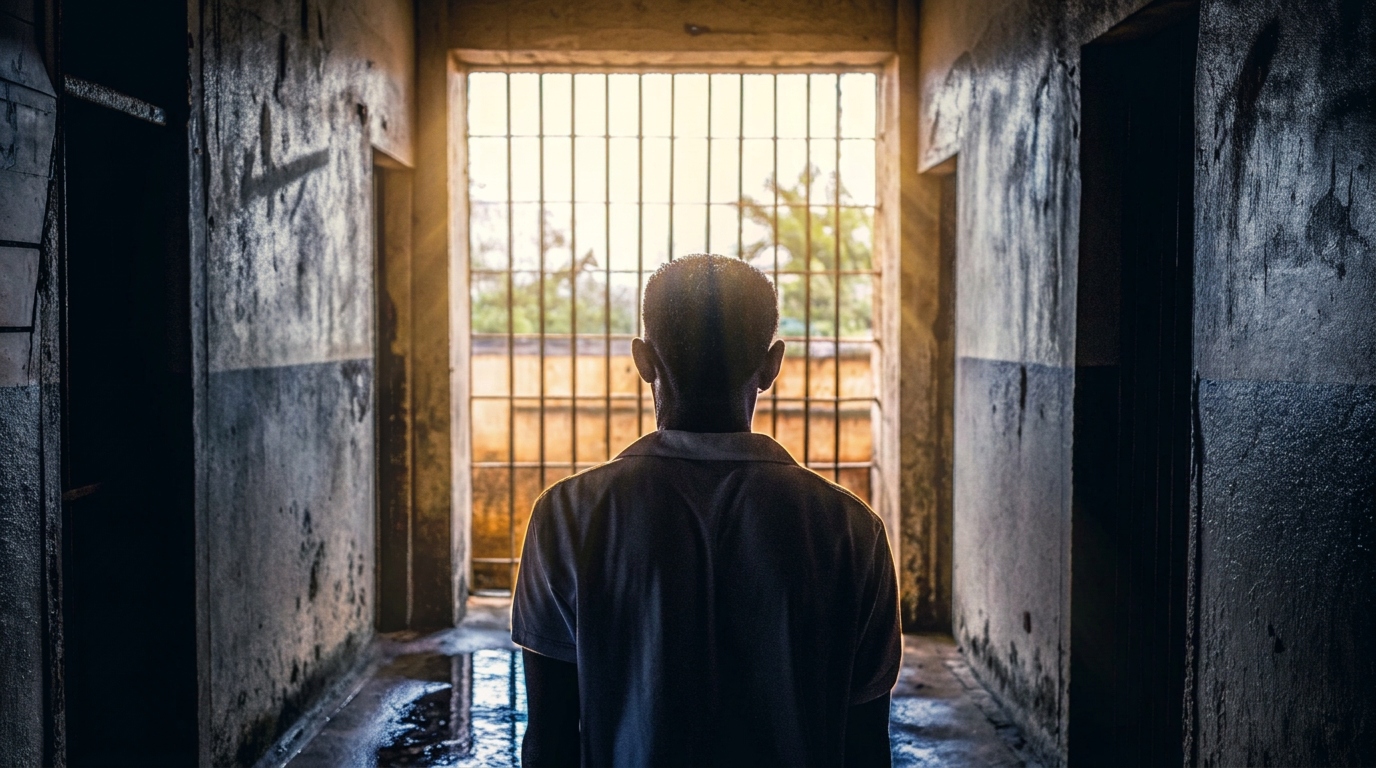
Some interviews end when the camera stops. Others follow you into the kitchen, sit beside you while the coffee goes cold and refuse to leave.
This was the second kind.
The man speaking had been away from Finland for 21 years. That long absence included Southeast Asia, Brazil, international drug trafficking, a murder conviction and about a decade inside Brazilian prisons. He had seen a knife stop millimetres from his heart. He had watched friendships evaporate as soon as they became expensive. He had lived through riots, isolation and the slow death of ordinary feeling.
Yet the thought that stayed with me was not the most violent one. It arrived near the end, almost quietly.
“Today may not have room for the miracle. Tomorrow does.”
That is not a cheerful slogan pasted over a nightmare. It is a survival rule spoken by someone who had reached days when the future seemed physically impossible. If you can remain alive until tomorrow, he says, tomorrow gives the world another 24 hours in which something can change. A phone may ring. A door may open. Help may arrive from a direction you could not see tonight.
Before that message makes sense, however, we have to walk through the story that produced it.
When crime still looked like a film
Long before prison, there was sport.
As a young man in Finland, he trained Brazilian jiu-jitsu and mixed martial arts when the local scene was still small. He competed. He trained seriously. There was enough discipline in him to become an athlete, perhaps even to build a respectable life around fighting.
There was another influence too. Crime had been sold to him through films, music, neighbourhood mythology and the people around him. It looked like a career with sharper clothes. Status came faster. Money appeared without the dull delay of qualifications, early shifts or a manager asking why you were three minutes late.
The illusion was powerful because it contained a few true things. Criminal work can require nerve, planning, long hours and social intelligence. The people involved may speak about loyalty, honour and responsibility. They may even believe those words.
But the language is borrowed. Underneath it sits a simpler contract: you matter while you are useful.
After losing a legitimate job in nightclub security, he did not picture himself stepping into ordinary retail work. His values were foggy, his pride was loud and the people around him offered a different route. He left for Thailand, intending to train and return for a scheduled fight.
He did not return.
One trip became a 21-year detour.
In Southeast Asia, the same criminal activity continued. So did the violence. He describes an ordinary restaurant evening that ended with a knife entering his chest near the heart and three major blood vessels. He says he lost nearly two litres of blood and temporarily lost sensation along one side of his body. There were other close calls involving firearms and a vehicle being overturned.
A sensible person might hear that list and think: stop.
He heard: move.
Brazil was familiar from earlier training visits. It was also a source country in the international narcotics trade, a vast place where legal commerce, desperate poverty, political power and organized crime could cross the same road without acknowledging one another. By the time he settled there, drug trafficking was no longer a sideline. It was his profession.
The ladder that only went down
The criminal ladder has an unusual design. Every higher rung takes you further underground.
Small bags became brick-sized quantities. Local dealing became logistics. Logistics became negotiations with people whose operations reached across borders and into public institutions. He was useful as a foreign organizer who could connect two ends of a chain without either end knowing the whole route.
That usefulness brought hospitality, gifts and access. It also created a fatal misunderstanding. Being welcomed is not the same as belonging.
He kept chasing cheaper supply, larger quantities and more powerful contacts. The closer he moved toward the source, the larger the potential margins became. So did the danger. As the product became cheaper, he says, human life seemed to lose value too.
At one point, he dreamed of having his own mark printed on packages. It sounds absurd now, even to him. At the time, it felt like proof that he had reached the top. In truth, he was trying to fill an old sense of not being enough with a brand, a reputation and a pile of money that could never become large enough.
That hunger has no finish line. There is always a bigger shipment, a harder man, a more secret room. Ambition does not disappear in the underworld. It loses its brakes.
He was also living without a valid immigration status and moving under different identification. Hotels replaced a home. Criminal contacts replaced a healthy circle of friends. When plans went wrong, he could not turn to the police without exposing himself. The apparent freedom of life outside the law had created a small, airless room.
Still, the parties continued. The work continued. Then one gathering went on for several days, sleep disappeared and a woman walked into the house with information that could threaten the entire group.
The sentence that could not be taken back
The interviewee does not offer a neat confession to the killing. Nor does he present himself as an innocent passer-by.
His account is more uncomfortable than either.
He says the woman threatened to expose people involved in a criminal operation. The house held several exhausted, heavily involved participants. Some had far more experience with lethal violence than he did. In that culture, hesitation could turn the person hesitating into the next perceived threat.
A group decision was made. Once made, he says, there was no ordinary way to withdraw from it.
The property was rented in his name. He had introduced one of the people involved. He says he left the house before the killing and returned to find the woman dead on the floor. By then, whatever he had wanted no longer mattered. There was a body in his living room, outstanding warrants elsewhere and no lawful exit he believed he could use.
The next decisions were made inside panic. Members of the group discussed how to dispose of the body. He says he opposed mutilating or dissolving it and took responsibility for another course. On a rain-soaked day, he helped bury the woman near the coast.
That act, he says, was his. He admitted it.
His wider responsibility is impossible to reduce to the final physical act. He had joined the operation, built the relationships, rented the place and accepted the rules of a world in which a threat could become a death sentence. He says he takes responsibility for everything he placed himself inside, even while disputing parts of the prosecution’s account of how the killing happened.
This distinction is not an excuse. It is the moral centre of the story.
Responsibility can be wider than a verdict. It can begin years before the night everyone later calls the crime.
One person caught, one story left
According to the interviewee, the main evidence against him was an anonymous statement from a local participant who claimed he had confessed. He says his fingerprints were not found where the prosecution’s theory would have placed them and that DNA beneath the victim’s fingernails belonged to another woman. Other members of the group were never arrested. Some later died.
He was the one in custody.
He describes himself as a convenient person around whom the whole case could be closed. A court convicted him of murder and concealing the body. The sentence was 18 years and 10 months.
Again, this article cannot settle the evidentiary dispute. A conviction exists. So does his account of ambiguity. Both belong in an honest telling.
What followed the arrest is less ambiguous in his memory.
He says he spent 47 days in a cell roughly the size of a telephone booth. There was a bottle for urine, a plastic bag for faeces and no shower. He also describes frightening night-time visits and abusive treatment during that period.
Outside, the network began to dissolve.
Other people left the country. Drug shipments and money disappeared. The men who had shared plans, meals and risk did not share the sentence. During his imprisonment, he says, none of the former associates who benefited from the operation sent meaningful financial help.
That was the criminal code in practice. Loyalty had looked solid when it was free.
When the bill arrived, it became smoke.
A prison can become its own country
The prisons he describes were not simply overcrowded versions of Nordic institutions. Some functioned as violent parallel societies.
In certain facilities, guards controlled the perimeter while prisoners controlled entire wings. Gates could be chained from the inside. Food was left outside and pulled through only when internal gatekeepers allowed it. Cells had no doors. Rival groups occupied opposite sides of a wall and worked through concrete from both directions, knowing that a breach could begin a massacre.
There were rules, but they were not the state’s rules.
Silence at a certain hour meant silence. Personal disputes could not be allowed to spread, because one fight might recruit two friends, then ten, then an entire wing. Large criminal organizations imposed order partly because uncontrolled chaos was bad for business. When those organizations chose war, however, the same machinery could turn prisons and city streets red.
The interviewee recalls riots, coordinated attacks, gunfire entering prison buildings and attempts to create distractions while escape tunnels were completed elsewhere. He says searches uncovered knives, firearms, explosives and bags of mobile phones. He remembers damaged wings left in use because there was nowhere to move hundreds of prisoners while repairs were made.
Food could be a cup of rice at midday and another at night. Hygiene was uncertain. He says meals were sometimes transported on the same trolleys used to remove bodies. Hunger eventually defeated disgust.
Then there were the images the mind should reject but somehow learns to store: human remains on a cart, bloodshed after factional fighting, men waiting to discover whether the wall beside them would hold until morning.
At first, such scenes burned into memory. Later, they began to blur. He believes the mind protected itself by reducing the emotional voltage. The protection came with a cost.
He describes becoming emotionally dead, a human ruin that kept moving because movement was what remained.
Strength was useful. Humility kept him alive.
People often imagine prison survival as a contest to identify the hardest man in the room.
He learned almost the opposite.
There is always a group capable of overpowering one person. A technically brilliant fighter cannot outfight a crowd, a blade in the dark or a decision already made by a whole wing. Physical ability helped him earn respect, but aggression without judgement would have made him a target.
What kept him alive, he says, was a mix of humility, fairness, courage and mercy.
Respect had to be visible in small things. Speak directly. Keep your word. Do not humiliate people for sport. Do not perform toughness simply because others are watching. If you can spare someone without making the community less safe, spare him. People remember.
That memory becomes a kind of social credit. Not a guarantee. Nothing in such a place is a guarantee. But if the community knows you once gave another person room to recover, it may insist that you receive the same room when your own judgement fails.
This is not softness. It is restraint under pressure.
Sport gave that restraint a structure. He trained three times a day when conditions allowed it. A physical session in the morning, movement in the yard, then yoga or meditation could remove six hours from a day that otherwise had too many.
He also fought.
He stopped counting after roughly 50 agreed contests, many held on concrete. Prisoners wagered bread, tobacco or small pieces of food. Improvised mouthguards were cut from rubber sandals. Crowds watched. Guards sometimes watched too.
These bouts were not the same as prison violence. They had consent, rules and an ending. Afterward, the men shook hands and returned to their cells to deal with bruises. The difference mattered. Sport let aggression pass through a channel rather than flood the entire place.
Still, there were moments when the stakes were life itself. Training helped. Character helped more.
The pen became a better weapon
At some point, he recognized that fighting the prison system with violence only strengthened the system’s case for more force, more funding and more restrictions.
So he asked lawyers for books.
He studied constitutional law, criminal procedure and the rules governing sentences. The work was slow. Prison paperwork is not cinematic. There is no swelling soundtrack when someone reads the same legal paragraph for the twelfth time under bad light.
Yet paper produced results that fists could not.
Many prisoners could not read. Some had no identification documents or reliable family contacts. Others had never seen their own sentencing papers. In that disorder, a person could remain locked up after the lawful end of his sentence simply because nobody with knowledge and access had asked the right court to look.
The interviewee began writing petitions by hand. He estimates that during a two-year period, his requests helped around 30 men obtain release after being held beyond their proper dates.
Inside a prison, helping someone regain freedom carries weight.
The work earned him protection of a different kind. More important, it gave his days a direction that did not depend on dominating someone else. The skills he once used to connect drug suppliers and buyers were being redirected toward forms, arguments and people whom the system had forgotten.
The change was not complete. Human change rarely arrives as a clean before-and-after photograph. But a new identity was starting to rehearse.
Seven months with almost nothing
The most decisive shift came in isolation.
He says a new rule prohibited prisoners from looking guards in the eye while speaking. One morning, he looked at a guard and said good morning. For that act, in the context of an already tense relationship with the institution, he says he was placed alone for seven months.
The cell measured roughly two and a half by three metres. There was little inside it. No ordinary social contact. No daily variety. Hunger, thirst, fatigue and pressure became the landscape.
He reached what he calls the edge of his absolute tolerance.
Near the end, he experienced something he describes as supernatural. He has chosen to reserve the full account for a longer telling, but he is clear about its effect. The experience convinced him that reality contained more than he could see from the cell. More strangely, his hatred vanished.
Not weakened. Vanished.
He could remember having wanted revenge against people who had harmed or betrayed him, but he could no longer reconnect with the feeling itself. When he returned to other prisoners, they told him he looked physically different, almost as if he had been resting somewhere pleasant. He laughed at the suggestion. Nothing about the cell had been a holiday.
Something had changed anyway.
Whether a reader interprets the event as spiritual, psychological or both is less important than what followed. He stopped organizing his future around revenge.
Forgiveness is not the same as trust
After prison, he made a series of calls.
Money was owed to him in several countries. Some of it was substantial. Collecting it would have given him a faster start. It would also have reconnected him to the same people, debts and threats that had built the old life.
He decided that a clean exit could not be financed with money already carrying blood.
He contacted people with whom unfinished business remained. He told them the old debts were finished. He forgave what had happened and made clear that the relationship was over.
One former associate replied that he forgave him too.
For what, exactly? The interviewee still does not know. The absurdity of the answer makes him laugh. It also reveals something important. Forgiveness does not produce a shared version of history. It does not make an unsafe person safe.
He did not promise renewed trust. He promised no revenge.
That boundary protected the future he was trying to build.
Freedom arrived without a welcome package
Release was not a single cinematic moment.
He says he was kept in custody more than a year beyond the point he believed he should have progressed, partly after a disputed psychiatric assessment. He had asked to complete an important evaluation in English to avoid misunderstandings, even though he spoke Portuguese well. In his account, the request offended the evaluator and contributed to an unfavourable report.
Eventually, he moved into home detention with a nightly curfew. There was no electronic tag. He needed money, so he returned to combat sports.
When permission to travel for a paid fight was not processed before the event, he went anyway. He needed the purse for rent. The decision sent him back to prison for another 60 days. A lawyer then clarified his eligibility, and in 2018, after about 10 years in custody, he entered conditional freedom.
He had no proper identification, no home, no job and no normal network waiting outside.
This is where many survival stories become vague. The door opens, music plays and the word freedom does the rest.
Real freedom is more administrative. It needs documents, rent, meals, transport and a reason to wake up. It also needs a new answer when the old telephone numbers promise quick money.
He began with what he knew.
Building a life from crumbs
He competed wherever a modest prize, a meal or a sponsor could help him continue. He taught mixed martial arts and grappling. One opportunity led to another. A short-notice fight ended quickly in his favour and opened the door to a respected, century-old Brazilian sports institution.
Later, he established a modest fight centre of his own.
The gym was not a palace. That was part of its value. It was physical proof that the new recipe worked: show up, teach, pay the bills, help other people improve, repeat. The space created jobs. It gave young people an alternative place to spend their energy. It supported community projects and became a base for coaching and other legitimate work.
The transformation did not erase the past. A gym cannot reverse a death. A legal income cannot make prison disappear from memory.
Redemption is not a receipt showing that the balance has been paid.
It is a direction. It is the decision to stop adding harm, then to keep choosing that direction when the old route still looks faster.
Combat sport, once part of the image he wanted to project, became ordinary work and service. The body that had been used to survive could now teach discipline. The ability to read a room could help a nervous beginner rather than manage a criminal negotiation. Even ambition found a safer job.
That may be the most believable part of the change. He did not become a completely different species. He redirected capacities that had always been there.
“Crime is a con”
Near the end of the interview, he speaks directly to young people who think organized crime looks exciting.
His answer is short.
“Crime is a con.”
Older participants see courage, hunger or insecurity in a younger person and identify a tool. They offer belonging. They make illegality feel like a test of character. The young person is valuable for as long as he can carry risk, move something, frighten someone or take the blame.
After that, he is disposable.
The interviewee’s alternative advice is almost aggressively ordinary: read, study, train, make art, believe that your abilities can become something lawful. Ordinary sounds boring only while disaster is still theoretical.
He is not saying every person involved in crime will receive a long prison sentence. His warning is darker. In the circles he knew, prison could count as the lucky outcome. At least prison sometimes left a person alive long enough to choose again.
There is no glamour in that arithmetic.
The practical size of hope
Hope is often presented as a feeling. Feel positive. Picture a better future. Trust the process.
This story offers a rougher version.
Hope can be a unit of time.
You do not have to solve the next year tonight. On the worst evening, even next week may be too large to hold in the mind. The task is smaller: do not make the irreversible decision before tomorrow has had its turn.
That idea does not excuse what happened in the past. It does not promise that every door opens. It does not claim that endurance alone repairs trauma, clears a conviction or returns a person who died.
It simply refuses to declare the future finished while time remains.
The man in the interview had more than one moment when he thought his story might be over. A blade had come close. Prison walls had held. Rival groups had waited on the other side of concrete. Isolation had narrowed the world to a few square metres.
Still, one day became the next.
Eventually, a phone did ring. A door did open. There was a fight, then a coaching job, then a gym. None of those things could fit inside the worst night because the worst night was almost over.
Tomorrow had more room.
That is the raw lesson beneath the crime story. Not that suffering automatically makes a person wise. Not that surviving cancels responsibility. Not that a brutal past should be admired because it produces a dramatic interview.
The lesson is simpler.
Stay alive long enough to meet the part of the story you cannot see yet.
Source and methodology note
This article is a narrative adaptation of an original Finnish-language long-form video interview.
The opening frame was also informed by an earlier Finnish reflection on the interview.
The transcript indicates a 21-year period away from Finland, an 18-year-and-10-month sentence and approximately 10 years in custody before conditional release. These are separate time periods and have been kept distinct here. Direct quotations have been translated and lightly condensed for clarity. Personal names, nicknames and identifying details about other participants have been removed.