
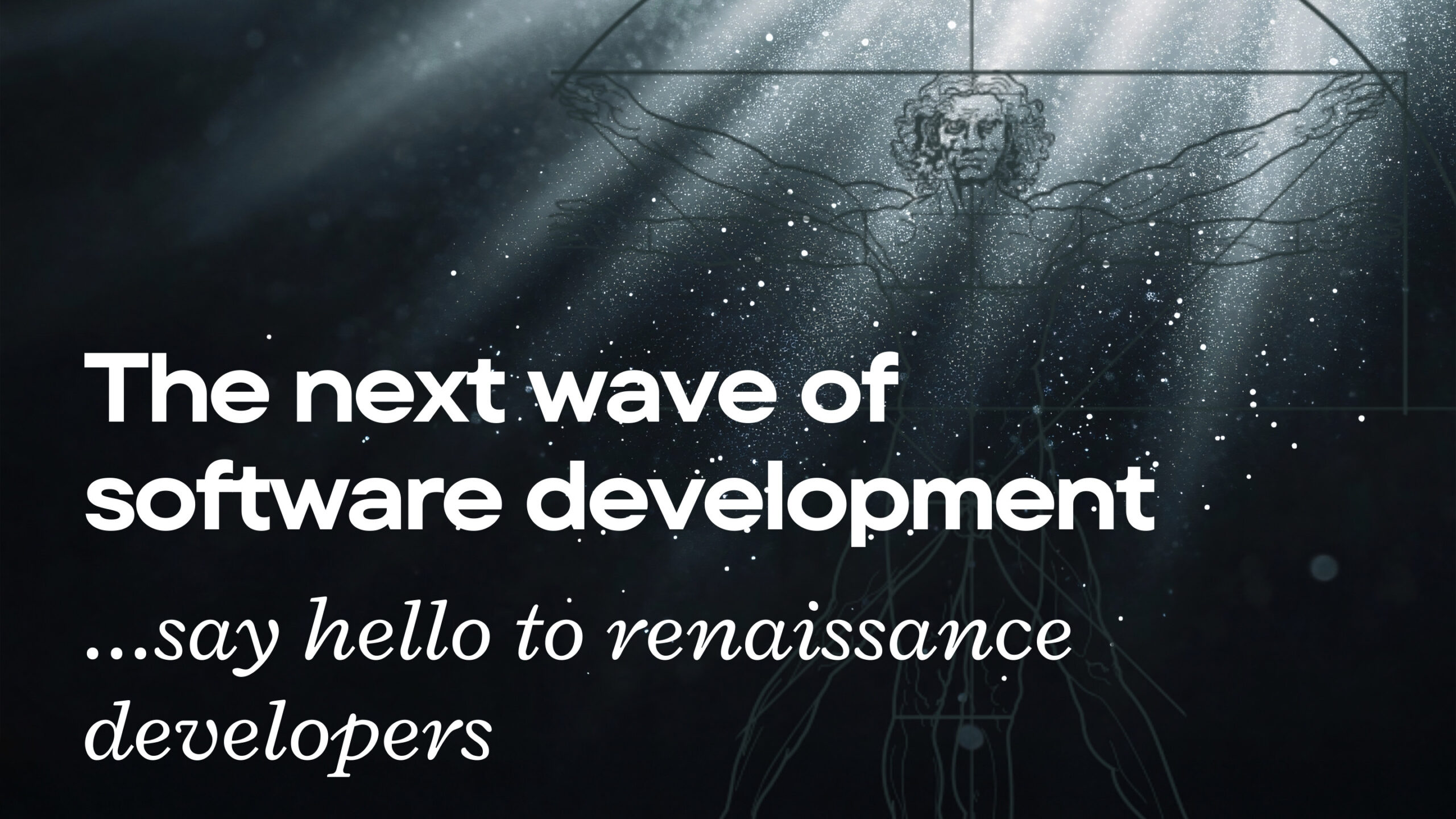
When AI starts writing code for you and roles begin to blur, one type of developer stands out from the noise – the renaissance developer. Not a superhero, but a multi-skilled human who can combine technology, business, and an understanding of people into one messy, living whole.
I recently stumbled on Werner Vogels’ article Tech predictions for 2026 and beyond on his All Things Distributed blog. He writes about “renaissance developers”, and I caught myself nodding a bit too enthusiastically at my screen.
Why did this particular idea stick? Because I come from a software development background and I’ve been building side projects in every direction for most of my life. I’m basically a wannabe renaissance man trying to cram code, creative work, business, music, and coaching into the same backpack.
“Don’t limit yourself to a single job title – soon that won’t be cool anymore.” – Mike Moisio
“Developers will disappear”? No – they’ll just change shape
The whole renaissance developer idea pushes back against a familiar story: “AI will take developers’ jobs, soon anyone can code.” We’ve heard variations of this before. When compilers showed up, people worried low-level programmers would be out of work. When cloud came along, ops people were afraid automation would wipe out their roles.
What actually happened? The level of abstraction went up, the barrier to entry went down – and developers ended up with more to do. When routine work gets easier, you don’t get less complexity, you get more ideas, more projects, more tangled systems. And somebody still has to truly understand them.
Generative AI is just the next chapter in that pattern. It can spit out code in seconds, but it doesn’t sit in a budget meeting listening to someone say “make it fast” while silently meaning “but don’t make it expensive”. It doesn’t know your company politics, your customers’ patience level, or the unspoken contracts inside your systems.
What a renaissance developer actually does
In the article, the renaissance developer of this new era isn’t described as a genius machine, but as a person who can speak several “languages” in the same head:
- they understand systems technically
- they see business, money, and risk
- they listen to people and translate talk into requirements
- they use AI tools, but don’t outsource their thinking to them
When I read the part about Da Vinci, I couldn’t help thinking about my own path: many years as in-house developer, then IT consultant, then coach. In between, bands, entrepreneurship, side projects, experiments – all the stuff that, from the outside, can look confusing or unfocused (not to say it wasn’t :). I caught myself smiling. Maybe it hasn’t been pointless wandering. Maybe it’s just an early, unfinished version of that renaissance developer mindset.
What this means for you and me
I don’t believe everyone has to turn into a modern Da Vinci. But I do believe the coming years will reward people who dare to blend two or three skills instead of hiding behind just one: code and customer understanding, writing and data, coaching and technology, or even music and machine learning!?
AI will increasingly help us with the technical side of the work. The responsibility for the outcome – its meaning, quality, and direction – still sits firmly with us.
For me, this was an encouraging reminder: keep building projects, keep learning, and don’t hide the “illogical” mix in your background. The era of silos and sterile corporate culture – especially the one I’ve seen in academic contexts – is quietly fading.
So my message to you, reading this on miketalks.blog: don’t shrink yourself down to one neat label. That trend is on its way out.
The world doesn’t need fewer developers and creators. It needs more renaissance developers – people brave enough to think bigger, break out of their silo, and still ship one small commit at a time.